Wednesday, June 9, 2010

Tancho Sanke


Monday should have been an easy day. I was almost done setting up two new aquariums and I was looking forward to having a better day after a week of reconditioning back some of my fishes that went on display the week earlier. And what do you know? Upon getting out of bed, I was shock to see my fiberglass fish pond almost empty of water! My super red arowana and other taller fishes were basically lying on their sides gasping as the water was more or less 2 to 3 inches! The others were a bit more 'fortunate' as there was enough to expose the dorsal fins above the water surface. Not wanting any additional distress to my fishes, the first thing I did was to refill the pond with fresh filtered water which fortunately went on maintenance the night before. At the end of the day, I lost my only Tancho Sanke (top-most koi in the picture above and whose head is partly covered by the tail of the showa).

So why am I sharing this to you? Sad as it maybe, I believe there is a lesson for all of us in here - and it is about equipment failure. I have always been a firm believer of over-filtration (which is actually a misnomer as one can never approximate nature's capacity) and always made sure I have the best equipment I could afford and unbelievably reliable too, but I also do miss out on some things at times. The loss of almost all of the water was not due to a leak from any cracks with the fiberglass material but simply from disconnection of the hose supplying water to the trickle filter from the pre-filter/pump which was easily preventable with the use of clamps to keep it in place. Just as simple as that and I lost a Tancho Sanke! The same thing happened to a hobbyist friend during the christmas holiday who lost many discus while his family was out of the country, and it was all because of a disconnected air tubing. Thus, here's the suggetion, or better still, add it to your checklist, always check on your connections, make sure they won't easily disconnect.

Tuesday, June 8, 2010

Things to Consider Before Buying a Pet

Cont’d....

An aquarium as a habitat is limited by the available space to start with. Although there are recommendations such as an inch of fish per gallon of water – originally only meant for the likes of smaller tetras but somehow became like a ‘mantra’ for every hobbyists afterwards even with wider and bigger fishes – studies have shown that fishes kept in an aquarium only grows on the average up to 60% of their maximum growth potential compared to that of fishes measured in the natural setting. With this limitation in space, it is thus highly suggested that one get the biggest tank one can afford and keep the number of inhabitants to a minimum.

Related to the available space which in reality also translates into volume is the realization that in reality, a typical aquarium is a closed system. The idea of a closed system is used here to differentiate it from the setting in nature which could be considered as an open one – where nature replenishes what it loses without any intervention. A river is a good example of an open system wherein nothing remains stagnant - upstream water replacing the water that flows downstream with all the waste materials that can be deleterious to living organisms that inhabits that particular space. A close system meanwhile is akin to a pail of water, evaporating a little each day, accumulating dirt thus in a few more days, the water quality will have deteriorated without human intervention. Or just imagine, a person living inside an fully-enclosed room where human waste is produced and not eliminated, the room will definitely will be unbearable once enough waste has accumulated. This is one of the rationales for doing regular water changes in a fish tank.

More tomorrow.....

Monday, June 7, 2010

Things to Consider Before Buying a Pet

Filipinos everywhere tend to keep pets - that literally means almost in every locale where an animal could be tended. Despite this propensity for keeping pets and at times, access to knowledge through the internet and from more readily available sources, very few knowledge is generated and shared that would raise the standard of pet keeping in the country. It doesn't help that a lot of the staff of local pet stores and even among hobbyists themselves are not as knowledgeable or have inadequate know-how and thus are unable to share or even communicate the very basics of pet keeping. Pet keeping should always be easy – convenient to the responsible pet owner and comfortable to the pet one has took care of. The same is true in fish keeping. I have met a lot who wants to get into fish keeping but are discouraged by the 'technicalities' of maintaining an aquarium or a pond. Is it really as technical as one always hear or as simple as others make of it?

I am taking a different tack here. First, one needs to remember that keeping pets will never be easy if one doesn’t understand the concepts of the needs of our pets. Thus, in more responsible websites, a prospective pet owner needs to answer several questions to ascertain whether the selected pet will fit into one’s lifestyle. This is one of the most important factors in any responsible pet keeping and is often the least of concerns for any trader and even to those who are considering taking in a pet. Take for example; the needs of an Asia arowana, the ideal recommended aquarium size is at a minimum of 6 feet (L) x 2 feet (H) x 2 feet (W). But how many keep theirs in smaller tanks? I am quite sure, the majority does. This discrepancy in providing for adequate housing for one’s pets already makes it more difficult in the longer term. And that is only an aspect of the basic needs of a pet one is to care for. Responsible care means one needs to know these basic needs not only in terms of the present but more importantly, in the future when a pet is fully mature. A responsible pet owner should learn more about the pet one is considering and obviously the problem lies when one relies mainly on what a trader shares. There’s a whole gamut of information published online and on paper and there is no reason to miss out on these.

Secondly, it is a matter of fact, that we can never really truly approximate what nature provides. It is imperative to state this now - any animal is best kept in their natural environment than owned as a pet. But once one owns one, then one should at least provide something near to the natural conditions with what one can best possibly afford. Unlike in their natural setting, an aquarium is quite a different habitat.

More to follow....

Friday, June 4, 2010

Corydora sterbai eggs


Two weeks ago, I was wondering which of the members of my South American community tank laid eggs on the glass wall. I wish the fish on the background - Pterophyllum altum - were the culprit but the angelfish aren't mature enough to spawn so it occured to me that any of the other fishes in the community were busy 'propagating' the species to say it more mildly. As I was busy then, I just had to let go of idea of catching the culprits 'in the act.'


A few days back, I was surprised to see two Corydora sterbais 'roaming' around depositing eggs on the walls of the fish tank. Unfortunately, I didn't have my camera ready.

Cyphotilapia Gibberosa Community Tank


One of my favorite fish from Lake Tanganyika despite all the controversies related to species identification. More commonly known as Zaire Blue Frontosa and sold as such, these group of Cyphotilapia gibberosas are now considered as entirely different from Cyphotilapia frontosa. The different commercial names like Mpwimbwe and Moba are based on collection point. Issues on inter-breeding between the two members of the genus cyphotilapia remains unanswered.

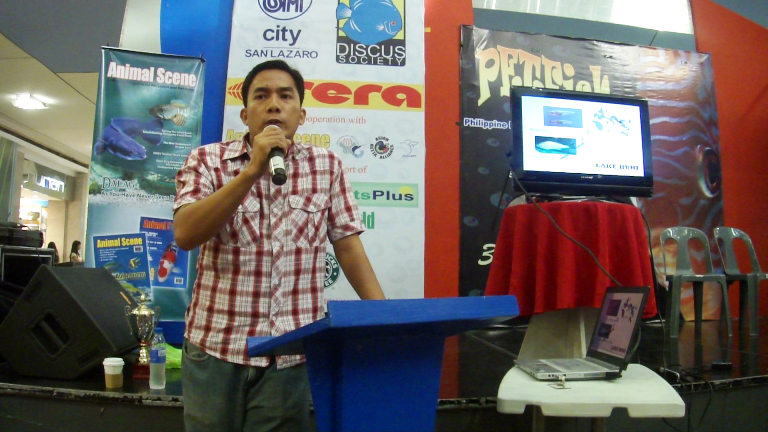
Dr. Ben Vallejo at PETFish 2010


Dr. Ben Vallejo is an environmental scientist who is working on Philippine endemic freshwater fishes. He is connected with the University of the Philippines Diliman. More on Ben with later posts.

Boni Labatos and Endemic Freshwater Fishes


Boni Labatos, a fish biologist and taxonomist also shared on our country's endemic freshwater fishes at PETFish 2010. He is presently working with the Asean Center for Biodiversity. More on Boni in future posts.